JURY VERDICT: Auburndale man guilty of shooting into vehicle

When Mark Childs saw his ex in a vehicle with a childhood friend, he confronted his friend, punched him through the driver’s window, and fired a handgun into the vehicle.

Mark Childs

Jurors deliberated just under two hours Tuesday before finding Childs guilty as charged of burglary with assault or battery, criminal mischief, shooting into an occupied vehicle with a firearm, and attempted aggravated battery. Childs is facing a minimum of 20 years in prison and will be sentenced Dec. 18.

Assistant State Attorney Aaron Henry told jurors that Childs behaved like a jealous and enraged boyfriend upon learning his ex-girlfriend had begun dating Cory Bisbee, one of Childs’ childhood friends.

On December 16, 2017, Childs saw Bisbee’s truck pull up to an intersection and realized his ex was in the vehicle as well. Childs followed Bisbee to Walker Fence in Auburndale, got out of his truck, and approached Bisbee on foot.

Childs asked his ex to get out of Bisbee’s truck, and she refused.

Childs then reached through the open driver side window and punched Bisbee in the face, shattering his glasses and cutting his eye. Bisbee put his truck in reverse to leave the parking lot, and Childs grabbed at the vehicle, breaking the side mirror.

As Bisbee was pulling away, Childs retrieved a hand gun from the center console of his vehicle. He pointed the gun at Bisbee’s truck and fired a round into it.

Childs got back in his vehicle and continued to follow Bisbee until being pulled over by law enforcement. A single bullet hole was found in the tailgate of Bisbee’s truck.

In an interview with law enforcement, Childs said he became upset upon learning his ex-girlfriend was dating Bisbee, whom he grew up with.

“It was a stupid decision,” Childs said. “I just lost control of myself.”

The entire incident at Walker Fence was recorded on surveillance cameras in the parking lot.

At trial Tuesday, the defense argued it was unreasonable to think Childs purposely fired a round at Bisbee’s truck.  He pointed jurors to Childs’ earlier testimony: “Check the tape. I 100 percent shot into the ground.”

“On the video, you do not see the gun pointed at a downward angle,” Henry said in closing arguments. “If I’m shooting at the ground, how does the bullet end up 30 feet away and still manage to hit the truck?”

Henry reminded jurors that when Childs was initially interviewed by law enforcement, he did not tell them he fired a gun toward the vehicle.

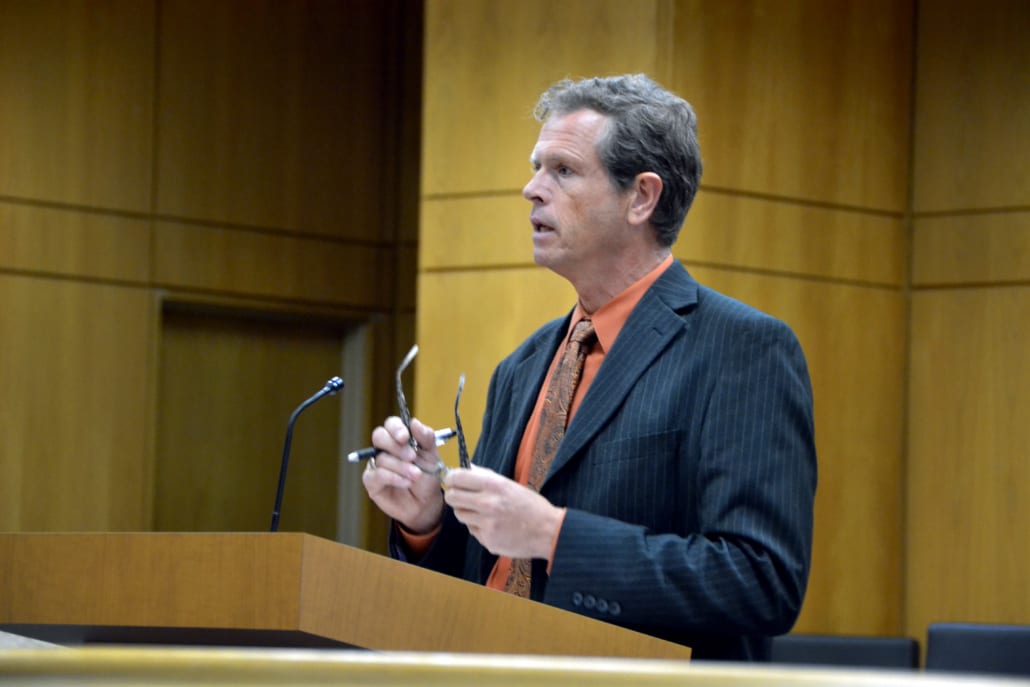
Assistant State Attorney Aaron Henry addresses jurors during closing arguments Tuesday. Childs was found guilty as charged and faces a minimum of 20 years in prison.

“He conveniently omits the very statement that incriminates him above all else,” Henry said. “It’s easy to say now that you didn’t have the intent to shoot into an occupied vehicle, but actions speak louder than words. And his actions show someone who became enraged.”

“He wants you to think he didn’t try to fire at Cory Bisbee, but then why did he take all these steps to do so? His intent is clear. He was angry, enraged, and jealous, and the only reasonable conclusion is to find him guilty as charged,” Henry said.


JURY VERDICT: Winter Haven man convicted of home-invasion murder

Tyler Macklin was at home on the phone with his friend when two men broke into his house, robbed him, and shot him in the head.

Joseph Gomes-Brandon

After five hours of deliberation Friday, jurors found Joseph Gomes-Brandon guilty of first-degree murder, robbery with a firearm, burglary, and conspiracy to commit armed robbery. He is facing life in prison without parole and will be sentenced Dec. 18.

Gomes-Brandon’s co-defendant, Jonathan Felix, was convicted of first-degree murder in September. Felix was sentenced to life in prison.

Assistant State Attorney Bonde Johnson told jurors that Gomes-Brandon, Felix, and a third co-defendant named Dylan Kindred decided to rob Macklin on the night of May 11, 2016.

Kindred orchestrated the entire robbery, but because he’d grown up with Macklin, Gomes-Brandon and Felix planned to enter Macklin’s duplex to steal from him while Kindred was waiting outside in the getaway car.

Gomes-Brandon and Felix kicked in Macklin’s front door and demanded cash and drugs while holding him at gunpoint. Macklin was on the phone with his friend, Michael Robago, who heard the robbers order Macklin to sit on the couch.

Robago then heard Macklin tell the robbers to take $300 that was in his wallet and whatever else they wanted from his house. Robago heard a gunshot over the phone and immediately drove to Macklin’s while keeping the phone line open.

But when Robago arrived at Macklin’s house just after 11 p.m., he found the door busted in and his friend lying lifeless in the middle of the living room.

At that point in the investigation, Johnson told jurors, law enforcement did not have any leads.

A few days after Macklin’s murder, Kindred went to his grandmother’s pastor and confessed what he and his co-defendants had done. The pastor then convinced Kindred he should tell law enforcement, so Kindred turned himself in.

Johnson told jurors in closings that the evidence fell into three parts: Kindred’s testimony, corroborating evidence, and phone records.

Kindred testified at trial, outlining the day of the murder and how he was with Gomes-Brandon at Salem’s and later at a Publix ATM. He also described the clothes Gomes-Brandon wore the day of the murder.

Surveillance videos captured both Kindred and Gomes-Brandon at these locations in the clothing he’d described, confirming Kindred’s testimony

Kindred also recounted how when Gomes-Brandon and Felix kicked Macklin’s door in, he saw neighbors come outside. Kindred, who was in the getaway car, pulled up in front of Macklin’s house, and the gunshot was fired.

That portion of testimony was confirmed by the neighbors, whose description of the car rolling toward Macklin’s duplex around 11 p.m. reflected what Kindred told law enforcement.

Law enforcement found a cigarette butt in the back seat with Felix’s DNA, which further corroborated Kindred’s testimony.

Phone records also show the communication between Kindred, Gomes-Brandon, and Felix. During the times when Kindred said they were together, at Salem’s and Publix, there is no phone activity.

“They were together,” Johnson said. “They didn’t need to call or text each other.”

There was no phone activity around the time of the murder, but then they’re communicating again around midnight, Johnson told jurors.

At trial, the defense argued that there was no physical evidence placing Gomes-Brandon at the scene.

“One of the reasons Kindred’s testimony is so credible is because he came forward on his own out of guilt or emotion because there was no physical evidence linking them to the scene,” Johnson said. “The cops weren’t looking for him – they weren’t looking for any of these three at that point.”

But Kindred turned himself in and confessed to the murder anyway.

“All of the corroborating evidence and witnesses and phone records make Dylan Kindred’s testimony believable,” Johnson said.

JURY VERDICT: Davenport man convicted of lewd molestation

When Daryl Penney’s victim asked that he stop touching her sexually, he responded, “I will try not to anymore.”

Daryl Penney

On a controlled phone call with law enforcement, the 15-year-old girl reminded Penney she said “no” and “stop” on multiple occasions. The girl asked him why he continued to touch her after she told him not to.

“I didn’t intend to,” Penney said. “I’m sorry you have to go through this.”

The jury deliberated for nearly two hours Tuesday before finding 32-year-old Penney guilty of lewd molestation. He is facing up to 15 years in prison and will be sentenced on November 19.

Assistant State Attorney Katie Ruel told jurors the sexual abuse began in January of 2017 and would happen every day – sometimes multiple times each day.

Ruel said the victim attempted to disclose the abuse to her mother but could not put it into words to tell her face-to face. So the girl wrote a letter – dated May 31, 2017 – and left it in her mother’s nightstand for her to find.

Around the middle of July, the victim realized her mother never received the letter. The girl then decided to write her mother a message detailing the abuse, and she sent it over Facebook.

The original, handwritten letter was later found stashed in Penney’s belongings in a garage.

Law enforcement questioned Penney regarding the allegations, and he admitted he was not perfect.

Detectives played the controlled phone call for Penney, and he denied touching the girl. But when one of the detectives asked Penney if the girl was lying about the allegations, he said he “would not call her a liar.”

Penney added he “would definitely try not to touch her inappropriately again.”

During trial, the defense claimed that both the mom and daughter had been working together to try to get Penney out of the picture and that these allegations were part of that plan.

But Ruel reminded the jury that the victim wrote and dated a letter nearly two months before the crime was reported, and the defendant himself took special measures to make sure it was not found.

SENTENCING UPDATE: Child rapist receives two life sentences

Matthew Baist stood motionless as Judge Abdoney handed down two consecutive life sentences Friday.

Matthew Baist, 33, of Davenport.

Following a jury trial Aug. 2, Baist was found guilty of sexual battery on a victim younger than 12 and sexual battery by a person with familial or custodial authority.

As a punishment for not finishing household chores, 33-year-old Baist raped his victim and beat her into submission when she tried to fight back.

The first assault took place a week before the victim’s twelfth birthday. When the girl tried to stop Baist’s advances, he hit her.

Baist continued punishing the victim by sexually assaulting her for about a month and a half.

When the victim found the courage to tell her aunt, she revealed that Baist had sex with her five times. The victim said the last time Baist forced himself on her, he choked her.

The doctor who examined the victim said her physical injuries were consistent with sexual abuse. DNA from a sexual assault kit was tested, and it was a match for Baist.

Baist initially denied being intimate with the girl, but after a series of controlled phone calls, he admitted to having sex with her.